Author Archives: kimhodgson

SOPHIA: Society of Practitioners of Health Impact Assessment

A group North American health impact assessment (HIA) practitioners and researchers recently launched a new coalition called SOPHIA: Society of Practitioners of Health Impact Assessment. SOPHIA promotes “a thorough and systematic consideration of health in decision-making”. Officially launched in late 2011, SOPHIA connects individuals and organizations who are actively conducting HIAs, interested in conducting HIAs, or have an interest in supporting the concept of HIAs. Membership is currently free, as long as you sign a statement pledging that you will conduct HIA in a manner that aligns with SOPHIA’s core values:

“As Health Impact Assessment practitioners, our work will reflect the following core values:

  • Democracy: emphasizing the right of people to participate in the formulation of decisions that affect their lives.
  • Equity: emphasizing the reduction of inequity that results from avoidable differences in health determinants and/or health status within affected populations.
  • Sustainability: emphasizing that decisions should meet the needs of the present generation without compromising the ability of future generations to meet their own needs.
  • Ethical use of evidence: emphasizing that transparent and rigorous processes are used to synthesize and interpret evidence, that the best available evidence from different disciplines and methodologies is utilized, that all evidence is valued, and that recommendations are developed impartially.
  • Comprehensive approach to health: emphasizing that health and disease are determined by a broad range of factors from all aspects of the physical, social and economic environment.”

For more information about SOPHIA, visit hiasociety.org.

Child Friendly Communities Transportation Toolkit

Child-friendly transportation is an essential component of a healthy, sustainable community. The Community Action Toward Children’s Health (CATCH) developed a toolkit for individuals, organizations and municipal partners to determine if a community includes child friendly methods of transportation. For more information and access to several practical resources (e.g. a self-assessment check list, child friendly transportation information for young children, and information for parents and municipal officials), click here.

Investing in Urban Agriculture

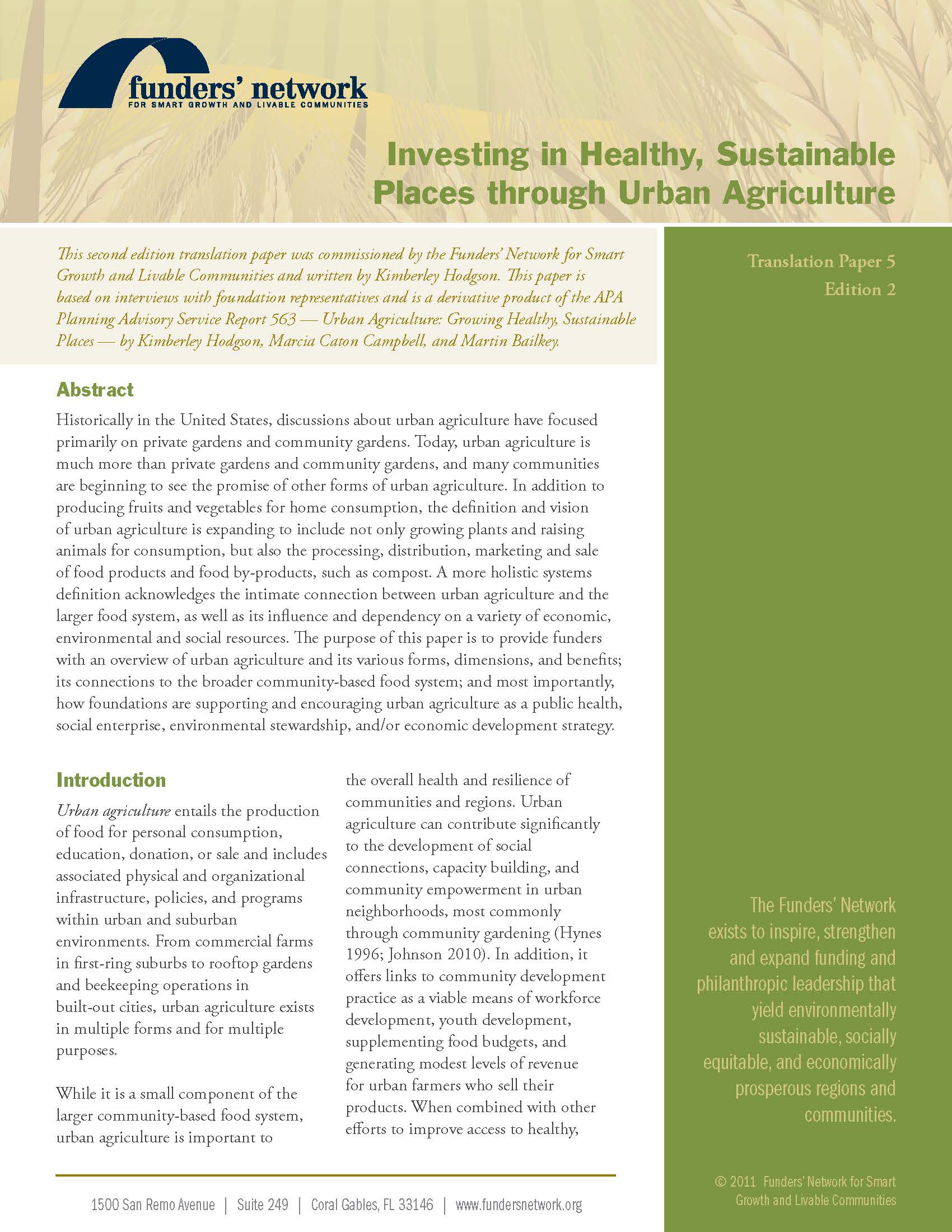
Historically in the United States, discussions about urban agriculture have focused  primarily on private gardens and community gardens. Today, urban agriculture is  much more than private gardens and community gardens, and many communities  are beginning to see the promise of other forms of urban agriculture. In addition to producing fruits and vegetables for home consumption, the definition and vision of urban agriculture is expanding to include not only growing plants and raising animals for consumption, but also the processing, distribution, marketing and sale of food products and food by-products, such as compost. A more holistic systems definition acknowledges the intimate connection between urban agriculture and the larger food system, as well as its influence and dependency on a variety of economic, environmental and social resources.

This new report (authored by Cultivating Healthy Places‘ founder, Kimberley Hodgson, and published by the Funders’ Network for Smart Growth and Livable Communities) explores how foundations are supporting and encouraging urban agriculture as a public health, social enterprise, environmental stewardship, and/or economic development strategy. For the full report, click here.

Public Health Program Coordinator Job (Tacoma, WA)

Tacoma-Pierce County Health Department’s Environmental Health Division is recruiting to fill a Regular, Full-time (1.0 FTE), Program Coordinator position leading a project to reduce and prevent chronic disease due to tobacco use, poor nutrition and/or lack of physical activity. Essential functions for this position include project management, team leadership and working effectively with extensive community partnerships.  The most competitive candidates will have subject matter experience with tobacco, nutrition and physical activity programs.  Excellent communication skills with community partners are required , including policy-makers such as members of the Board of Health, city and county councils and school boards.  This is an administrative, managerial classification, in the Environmental Health Division, under the direction of the Environmental Health (EH) Division Assistant Director. For more information, click here.

Promoting Healthy Eating and Sustainable Local Food in BC

The BC Provincial Health Services Authority partnered with the Union of BC Municipalities, Vancouver Coastal Health, and the ThinkandEatGreen@School Project at the University of British Columbia to develop an action guide for health authorities, educational institutions, childcare facilities, and local governments on how to support the determinants of healthy eating while promoting a local and sustainable food supply. For more information, visit: Promoting Healthy Eating and Sustainable Local Food in BC: An Action Framework for Public Institutions – Health Authorities, Educational Institutions, Childcare Facilities, and Local Governments.