Author Archives: kimhodgson

Cultivating Healthy Places Named Co-Investigator of a $3.96 Million USDA Grant to Promote Food Security

Cultivating Healthy Places’ founder and principal consultant, Kimberley Hodgson, received a 5-year contract as co-investigator for a $3.96 million grant awarded to the University at Buffalo from the National Institute of Food and Agriculture, Agriculture and Food Research Initiative Food Systems Program, a program of the United States Department of Agriculture.

The project, “Building Local Government Capacity to Alleviate Food Deserts”, will improve the ability of urban and rural communities to create, implement, and sustain policies that simultaneously enhance food security and foster a healthy local agricultural sector. This project is about making the food system work for vulnerable consumers and farmers who are not well served by our contemporary food system – consumers with limited access to nutritious foods, and small, mid-sized and limited resources farmers.

Hodgson’s co-investigators in this endeavor are Samina Raja, PhD (the project lead, University at Buffalo), Julia Freedgood (American Farmland Trust), and Jill Clark, PhD (Ohio State University). Key partners include the American Planning Association and individuals from other national non-profit organizations.

The project will begin with a national survey to identify and evaluate the effectiveness of innovative food systems policies in reducing food deserts and strengthening the local agricultural sector. Drawing on the successes and failures of these policies, the team will develop policy tools and provide technical assistance to 20 vulnerable urban and rural communities in the United States to build the capacity of their local government staff, extension educators, consumers, and farmers to develop and implement more effective food system policies.

In order to nurture the next generation of food systems policy thinkers and professionals, the team will prepare and disseminate multi-disciplinary curriculum materials on food systems policy for adoption in universities across the United States. The team will also launch a doctoral fellowship in food systems planning – the first in the United States.

Earlier this year, Hodgson founded Cultivating Healthy Places, an international consulting business that specializes in social equity, community health, and resilient food systems planning. As a certified planner and registered dietitian, Hodgson conducts policy-relevant research and provides technical assistance to private, public, and non-profit organizations in the United States and Canada on the design and development of healthy, sustainable places.

This project will build on Hodgson’s wealth of professional and educational experience related to food systems policy. Hodgson recently co-authored the American Planning Association’s seminal publication on urban agriculture, “Urban Agriculture: Growing Healthy Sustainable Places” (January 2011), and the “Principles of a Healthy, Sustainable Food System“. Hodgson also completed a 3-year American Planning Association research project that was funded by the Robert Wood Johnson Foundation to evaluate how local comprehensive and sustainability plans address and work to improve food access equity.

Currently, Hodgson is providing guidance to the City of Lawrence and Douglas County, Kansas and the City of Vancouver, British Columbia on the development and implementation of local level policies to support and enhance the local food system; co-developing a community agriculture plan for an area in Delta, British Columbia; and conducting research on the management and productive reuse of vacant properties for the Metropolitan Institute at Virginia Tech.

Hodgson is a member of the American Planning Association, Canadian Institute of Planners, and the Vancouver Food Policy Council.
Potential for Urban Agriculture in Boston

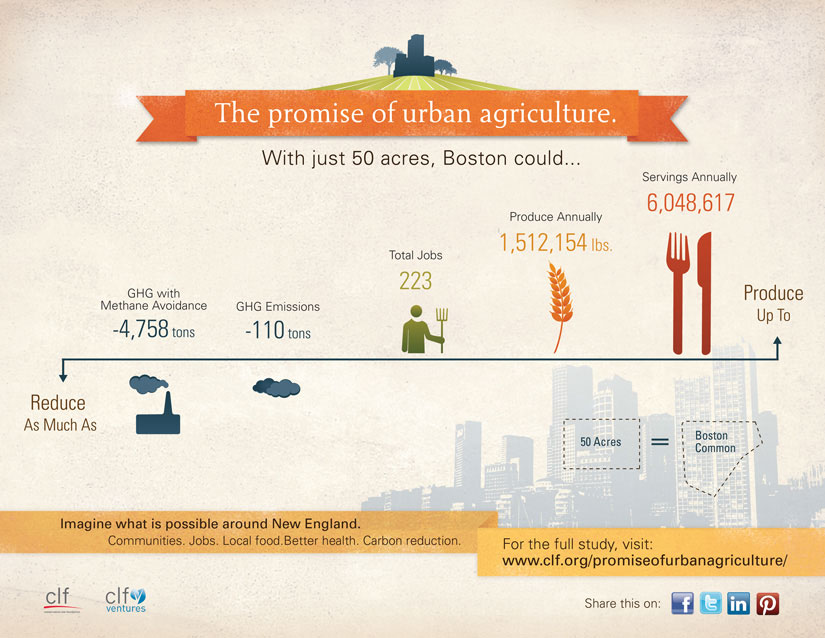
What can 50 acres of underutilized, vacant property provide for the greater Boston region?

The Conservation Law Foundation published a new report – Growing Green: Measuring Benefits, Overcoming Barriers, and Nurturing Opportunities for Urban Agriculture in Boston – that explores the economic development potential, assesses the environmental and health co-benefits, and examines policy barriers to expanding food production in the Boston region.

Key findings of the report include:

  • Land is available. 50 acres – an area the size of Boston Common – is a small portion of the vacant or underutilized land available in Boston.
  • Urban farms would stimulate the economy by creating jobs. 50 acres of urban agriculture in Boston will likely generate at least 130 direct farming jobs and may generate over 200 jobs depending on actual business characteristics and revenue.
  • Healthy, local and affordable food. 50 acres in agricultural production would provide enough fresh produce to feed over 3,600 people over a six-month retail season. If the produce is used to prepare healthy school lunches in Boston Public Schools, 50 acres could provide more than one serving of fresh produce for each lunch served to a student eligible for free or reduced school lunch over a six month period. If 800 acres of potentially available City-owned land were put into agricultural production, the food needs of approximately 10 percent of Boston’s total population could be fully satisfied during a six-month retail season.
  • Significant environmental impacts. Urban agriculture in Boston will result in a net reduction of greenhouse gas (GHG) emissions. 50 acres of properly managed soils would sequester about 114 tons of cabon dioxide (CO2) per year and may result in an additional CO2 reduction of up to 4,700 tons per year.

For more information, click here.

Food Access: The Missing Sustainability Planning Topic?

This summer, the American Planning Association will publish a policy report that outlines the results of a 3-year research study of how local governments in the U.S. are planning for food access and the greater community-based food system.

Of a sample of 888 local governments across the U.S., the study identified 105 jurisdictions that explicitly addressed food access and other food systems issues in their comprehensive or sustainability plan. The top most-cited food system strategies included:

  • preserving rural agricultural land;
  • supporting new opportunities for the agricultural production of produce;
  • improving access to farmers markets and community gardens; and
  • supporting new opportunities for urban agriculture.

For more information about this study and a summary of results, click here.

Healthy City for All

On Friday, June 22, 2012, the City of Vancouver, British Columbia held a special event to announce the development of a new planning process: the Healthy City Strategy. The half day, public event (Healthy People, Healthy City – Making Vancouver a leader in urban health) featured local and national speakers, including Vancouver Mayor Gregor Robertson, Vancouver City Manager Penny Ballem, Vancouver Coastal Health Chief Medical Health Officer Patricia Daly, and The Globe and Mail Reporter Andre Picard. Local leaders highlighted their work through short, pecha kucha style presentations and panelists discussed the need to address diversity and income equity as central components to the strategy.

“Inequity is the root of all health problems,” said Andre Picard in his opening keynote address. Some of the healthiest cities in the world have the smallest gaps between the rich and the poor.”Good health doesn’t happen by accident.” But rather cities need to to recognize that every public employee is a “de-facto public health official”, particularly planners. Healthy people are only as healthy as the city in which they live, he explained.

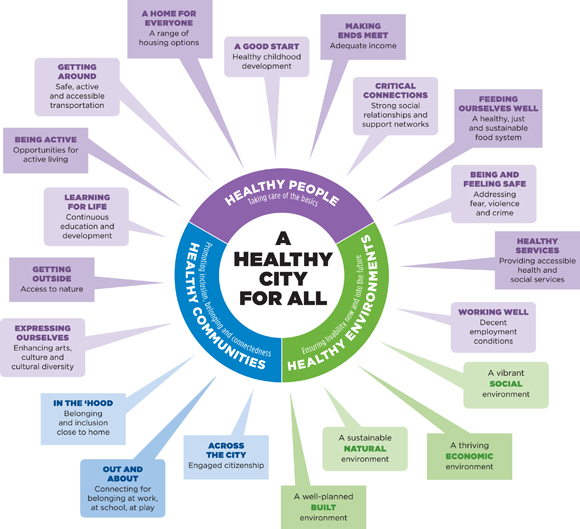
The Healthy City Strategy is one of three city-wide plans that make up Vancouver’s recent sustainability planning efforts. This plan will focus on creating a long-term strategy to create healthy people, healthy places, and healthy communities, and will be based on a robust and comprehensive framework (see graphic above). The other two plans focus on the ecological and economic pieces of sustainability: the Greenest City Action Plan and the Vancouver Economic Action Strategy.

This ambitious planning process is a collaborative effort of the city and the health authority (Vancouver Coastal Health). The strategy will address a range of urban health issues such as affordable, healthy housing, food access, employment conditions, accessible health and social services, community engagement, fear and violence, active living, healthy childhood development, and much more.

NYC Zoning Amendment to Accommodate Rooftop Agriculture

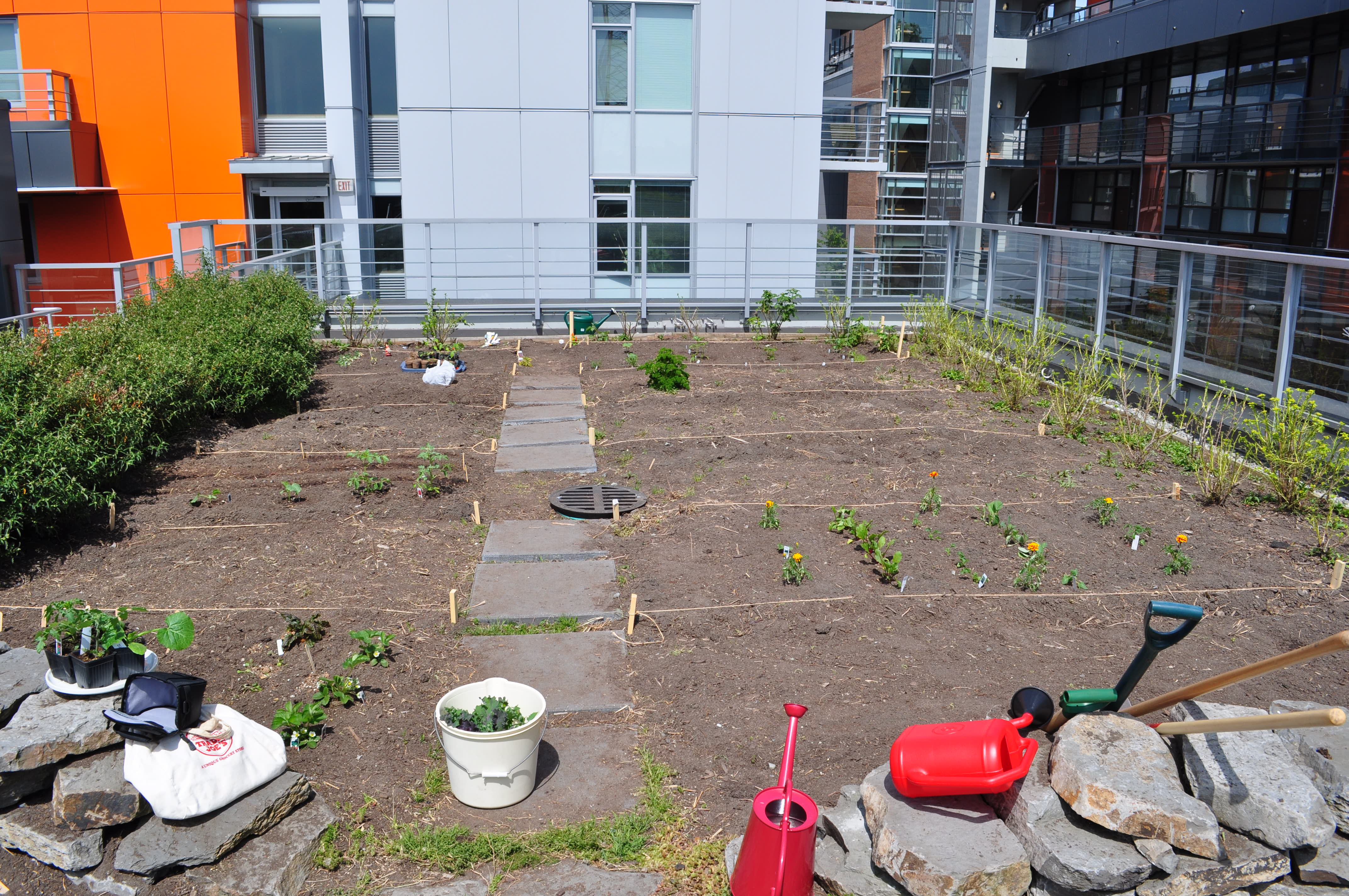
In built out cities, like San Francisco, Vancouver, Seattle and New York City, land is difficult to come by for urban agriculture. However, many cities are discovering an untapped resource: rooftops. In December, New York City’s Department of City Planning proposed a zoning amendment that would exclude urban agriculture operations, such as greenhouses, on commercial buildings from certain height and floor-area restrictions. On April 30, 2012, the New York City Council approved the Zone Green Text Amendment. The amendment allows greenhouses to be “exempt from floor area and height limits, provided that it is located on top of a building that does not contain residences or sleeping accommodations. These greenhouses must not exceed 25 feet in height, must set back six feet from the roof edge, and must include practical measures to limit water consumption.”

According to a recent study by the Urban Design Lab at Columbia University, there is over 3,000 acres of rooftop on commercial and industrial buildings in New York City that is potentially suitable for urban agriculture. For more information, visit the links below:

Reclaiming our Food Systems: Policy and Practice

BC Food Systems Network 14th Annual Gathering

Mark your calendars…this July 5-8, 2012, the BC Food Systems Network will be hosting their annual gathering at Camp Fircom on Gambier Island (just outside Vancouver, British Columbia). The focus of this annual gathering will be policy and practice. From workshops and presentations, to a wide range of structured and unstructured activities, the gathering aims to bring people together from across British Columbia, and beyond, to share and learn from one another about how to create healthy, more sustainable food systems.